


The Energy of Fascia
The Energy of Fascia: Patterns, Vibrations, and the Symphony of the Body
The Silent Song Beneath Our Hands
Every reflexologist knows the feeling — your hands rest on a client’s foot, and something subtle yet unmistakable greets you. It’s not simply warmth or texture, but a sense of tone, a “hum” beneath the skin. Sometimes it feels harmonious, other times slightly off. What you are sensing may be more than mechanical tension — it may be the body’s vibrational language, carried through the fascia.
Fascia has long been described as the body’s connective web — wrapping, linking, and supporting every cell, every organ, every structure. But fascia is more than scaffolding. It is a living, pulsating network, constantly transmitting information. And the medium of that information is vibration — patterns of subtle movement and energy that shape how the whole organism coordinates itself.
When we touch fascia, we’re not only working with matter. We are joining a conversation.
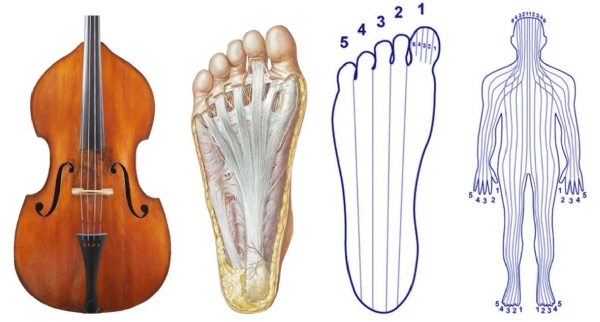
From Anatomy to Energy
Traditionally, we’ve studied fascia in terms of continuity and layers — how it connects foot to head, muscle to bone, organ to organ. We’ve explored techniques to stretch, release, and mobilize it. But fascia is also a sensory and communicative organ. It is packed with nerve endings and sensitive to changes in tension, pressure, and frequency.
In this sense, fascia acts much like an antenna: it receives and transmits signals. Some of these signals are mechanical — the tiny oscillations of muscles and fluids. Others may be electromagnetic in nature, related to cellular activity. Together, they create a whole-body vibrational field that is constantly adjusting, adapting, and self-correcting.
Information is Pattern
If we think of information simply as “data,” we miss the essence of what the body does with it. In living systems, information is pattern. It is the shape of movement in time — a rhythm, a pulse, a frequency. These patterns can be regular and coherent, or they can be irregular and chaotic.
You’ve likely seen cymatics images — grains of sand or water forming intricate geometric shapes under the influence of sound. Fascia, too, responds to vibration by adopting certain structural patterns. And these patterns may be linked to health: coherent, harmonic patterns tend to accompany ease and vitality, while disordered patterns often appear with pain, inflammation, or restriction.
It’s possible that each organ, tissue, or cell group has a “home note” — a baseline resonance where it functions best. When stress, injury, or chronic tension interfere, that note may be dampened or distorted. Our work, then, could be seen as helping the body remember its original song.
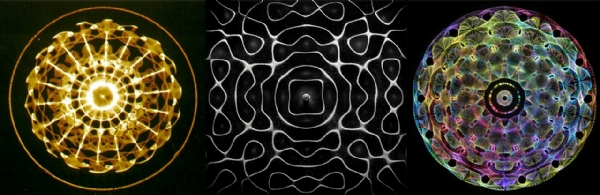
A Hierarchy of Frequencies
One way to imagine the body’s vibrational field is as an orchestra:
Cells are the high, delicate instruments — their micro-vibrations quick and subtle. Tissues provide slower rhythms, like the heartbeat or breathing cycles. Organs contribute their unique tonal qualities, shaped by their structure and function. The whole body produces an integrated “score” — a unified pattern of movement and tone.
What This Means in the Clinic
Recognizing fascia as a communication web changes how we approach our sessions. Instead of thinking only about mechanical release, we can think about resonance restoration.
Practical ways to work with this awareness:
Attunement: Before beginning, rest your hands lightly and sense the tone under your fingers. Is it lively or sluggish? Smooth or choppy? Pattern recognition: Over time, you may notice recurring qualities — a certain “buzz” in one client, a deep stillness in another. These are part of the vibrational language. Facilitation: Gentle, sustained contact, slow rhythmic pressure, or subtle rocking can invite tissue to shift toward its natural frequency.
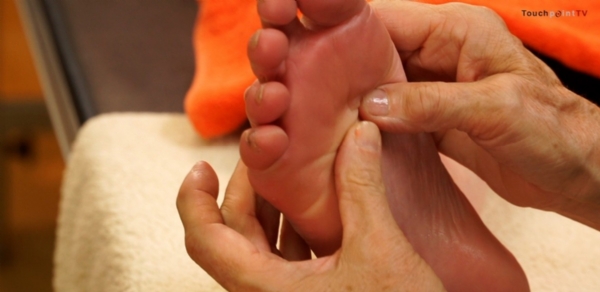
An Invitation to Listen
The next time you rest your hands on your client’s feet, imagine the entire fascial web responding — like a vast instrument waiting for its strings to vibrate. Somewhere within that web lies each cell’s fundamental note, each tissue’s rhythm, each organ’s unique timbre.
Your role is not to force the music, but to listen deeply and offer the conditions in which the body remembers its melody. Because healing, in the end, may be less about fixing what is wrong, and more about helping the body rediscover its own natural song.
“Reflexology is the restoration of resonance.”

Ryesgade 27
DK-2200 Copenhagen N
Denmark
Tel: (+45) 2575 7047
Email >